My thoughts on “Before The Coffee Gets Cold”
If you could go back to any point in your past, knowing that it won’t change your future, would you do it? Where would you go? What would you do?
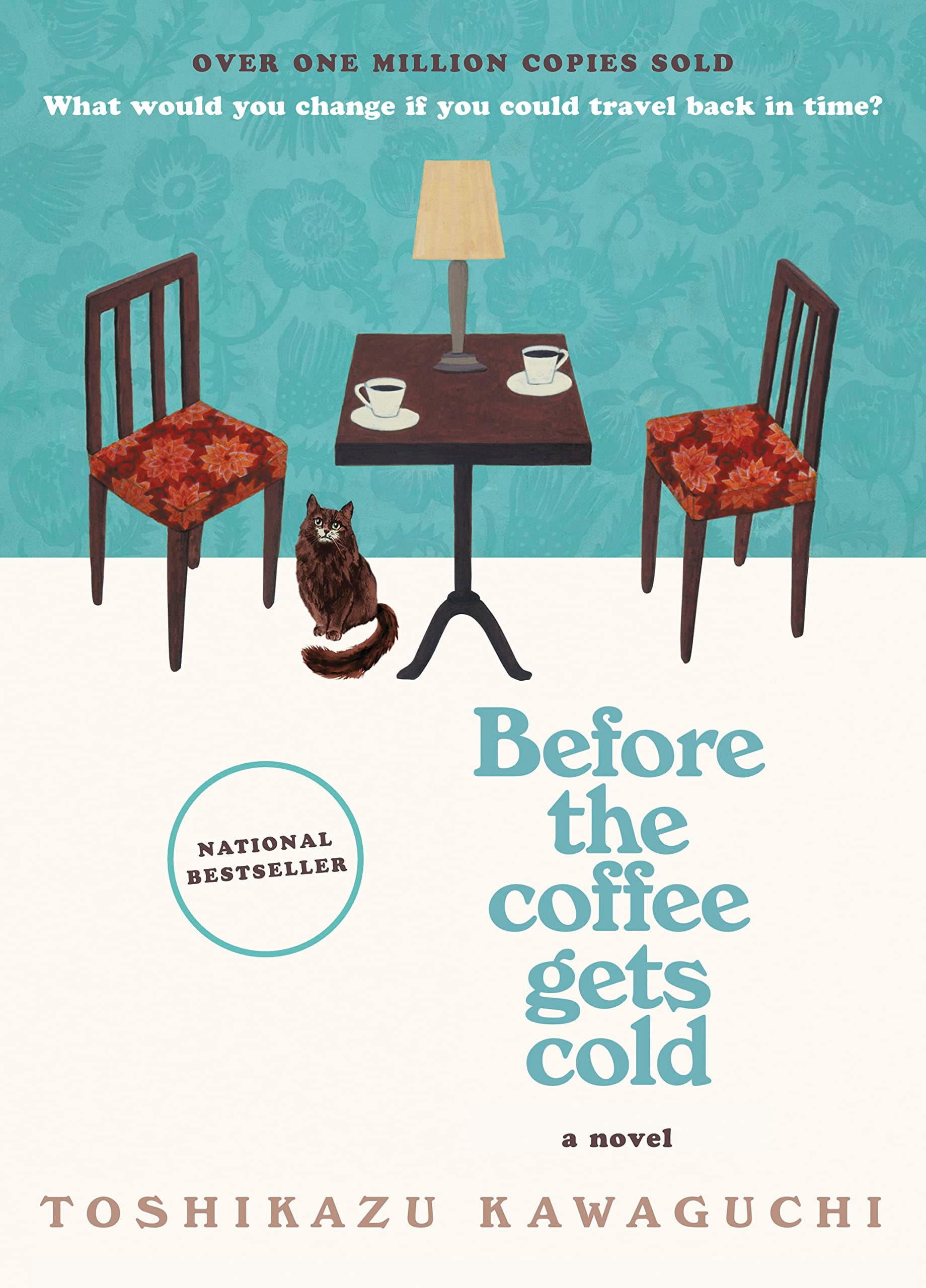
“Before the Coffee Gets Cold” is one of my favourite books of all time.
The book delves into the interconnected lives of patrons at a mysterious Tokyo café, where there is a special chair that lets you revisit your past based on a set of rules.
Rules:
- Sit at the specific chair, drink a cup of coffee, and go back to your past.
- You may only meet a person who has visited the café before.
- You must return before the coffee gets cold.
- No matter what you say or do, the present cannot be changed.
If you don’t return before the coffee gets cold, you are trapped as a ghost.
The Book
 Cocoa Mountain, Durness, Scotland
I think most people would start off this book by telling themselves that they would visit any person in the past, knowing it won’t change anything in the present. At least I did. But after reading this book, I’ve questioned that idea.
We’ve all imagined or even dreamed of ourselves going back to our past, doing more for ourselves and others, taking back hurtful words, undoing regretful actions, and more.
It provides us with a sense of comfort in our decisions, a mechanism to feel less regret, or just an interesting thought experiment. But following the experiences of the characters, the book lets you think of the possibilities that my wishful daydreaming simply could not think to realise.
Fumiko and Goro
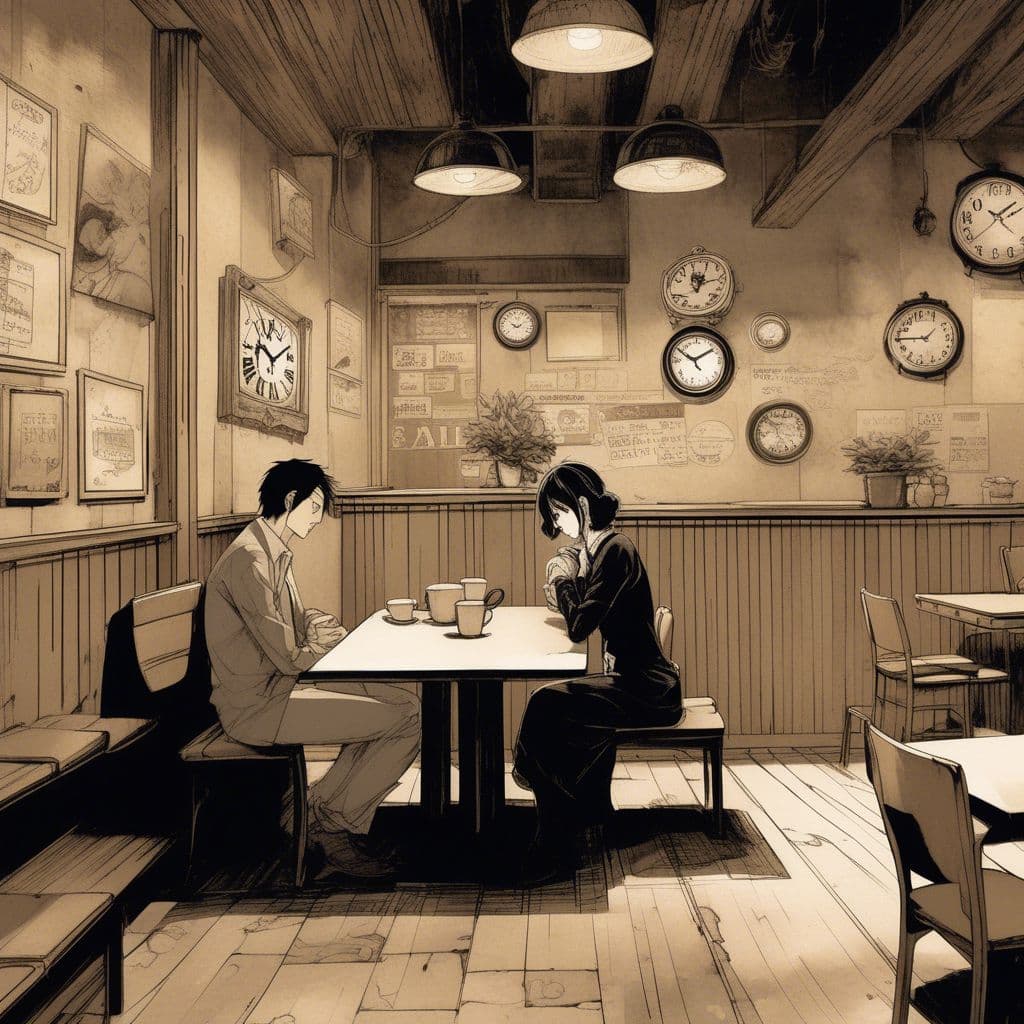 Fumiko and Goro - https://www.bookey.app/book/before-the-coffee-gets-cold
Fumiko is a successful project director wanting to confront her ex-boyfriend, Goro, who suddenly left her to pursue his dream job in game development at a US company.
Fumiko and Goro met at the café where Goro revealed that he has accepted his dream job and is flying out to the US in a few hours, concluding their relationship rather suddenly.
Goro had insecurities about not being good enough for Fumiko due to a scar on his forehead. Fumiko stayed silent throughout the breakup, later heavily regretting not asking Goro to stay.
Fumiko uses the café to go back and relive their breakup at the café, and imagine what could have been had she told Goro to stay.
I don’t really have any personal attachment to this story, but this story continues to remind me to be a communicator in any form of relationship.
Communication continues to be one of the leading causes for breakups and divorces. We’ve all experienced both miscommunication and bad communication and have learned to be better communicators through personal experiences. One thing I’ve always debated was whether to overcommunicate or undercommunicate.
When we overcommunicate, we tend to share incomplete and premature thoughts, perhaps thoughts that we rather should have thought more about before sharing. When we undercommunicate, we tend not to share enough information, making people think we are being secretive or passive.
I don’t really include perfect communication because, frankly, no one is a perfect communicator. It’s like trying to balance a single chair leg on a rock, it’s almost impossible to find the right balance.
Undercommunicating may lead to situations like Fumiko and Goro, where we don’t share enough and leave the situation with regret. But as a thought experiment, had Goro and Fumiko overshared, sure, it may have led to Goro not leaving Fumiko to go the US, but it may have also brought up more issues and insecurities in the relationship.
I’m not going to pretend I know the correct amount of communication in relationships. But I always try to find the right balance with people. How do they react to underdeveloped thoughts? How well can they keep secrets? How much do they take you seriously? What’s your relationship with them? They’re all important factors when thinking about how much to communicate in our relationships.
Fusagi and Kohtake
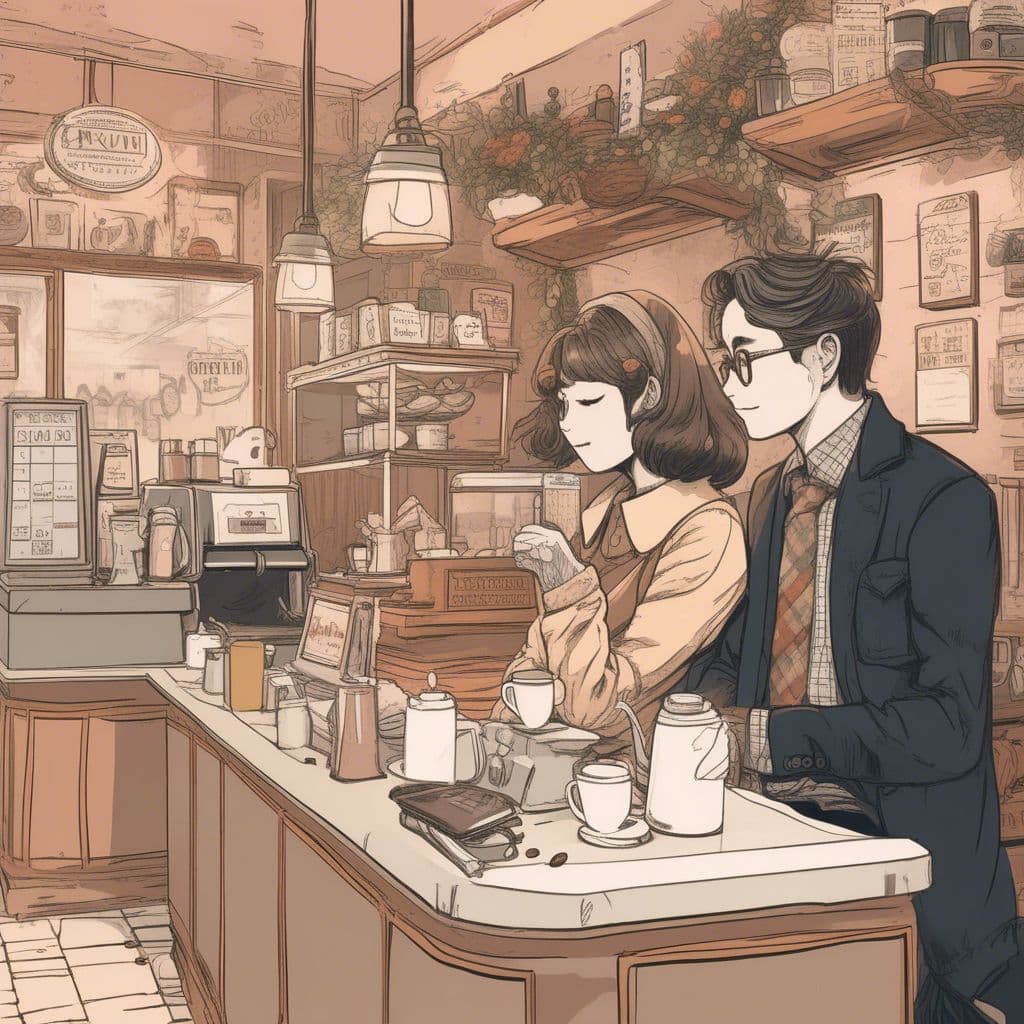 Fusagi and Kohtake - https://www.bookey.app/book/before-the-coffee-gets-cold
Fusagi is a long-time regular customer at the café and has an early-onset Alzheimer’s. His wife, Kohtake, is a nurse at the nearby hospital who comes to the café regularly to pick up her husband.
While still in love, the memory issues that stem from Fusagi’s Alzheimer’s deeply affect Kohtake. Kohtake goes back in time to reminisce about her husband before he had Alzheimer’s, and on a particular visit, receives a letter from him.
The letter was written by Fusagi after being diagnosed with Alzheimer’s. He writes that he wants Kohtake to stay with him as his wife, not just a nurse who takes care of him.
More importantly, Fusagi gives Kohtake permission to leave him if the burden becomes too much. To me, this story was probably the saddest story in the entire book.
Alzheimer’s disease affects 7-9% of people aged 65 and older 1. We see and hear of Alzheimer’s cases all around us.
I personally know someone who has early-onset Alzheimer’s. When I talk to them, it’s a tense feeling because everything seems fine until they completely forget something about the conversation or a detail about the past. Not only does it throw your mental state off completely, it just brings a feeling of sadness.
In Kohtake’s case, she had the ability to go back in time through a fictional time machine and relive their happy moments, even receiving an unexpected letter that allows her to embrace their marriage even further, years after the onset of Alzheimer’s.
But if I had access to this fictional time machine, yes, it would be amazing to relive the memories of the person who still retains their memory. But I fear that after the trip, I would just get depressed thinking about what used to be and what actually is now.
Maybe that’s just the pessimism in me, and there’s probably a more hopeful way to spin this, but going back in time and reliving those moments would open too many possibilities that I feel will be out of my control, bringing much more emotion than I need in my life.
More importantly, I would probably fail to stick to the rules and let the coffee get cold.
Hirai and Kumi
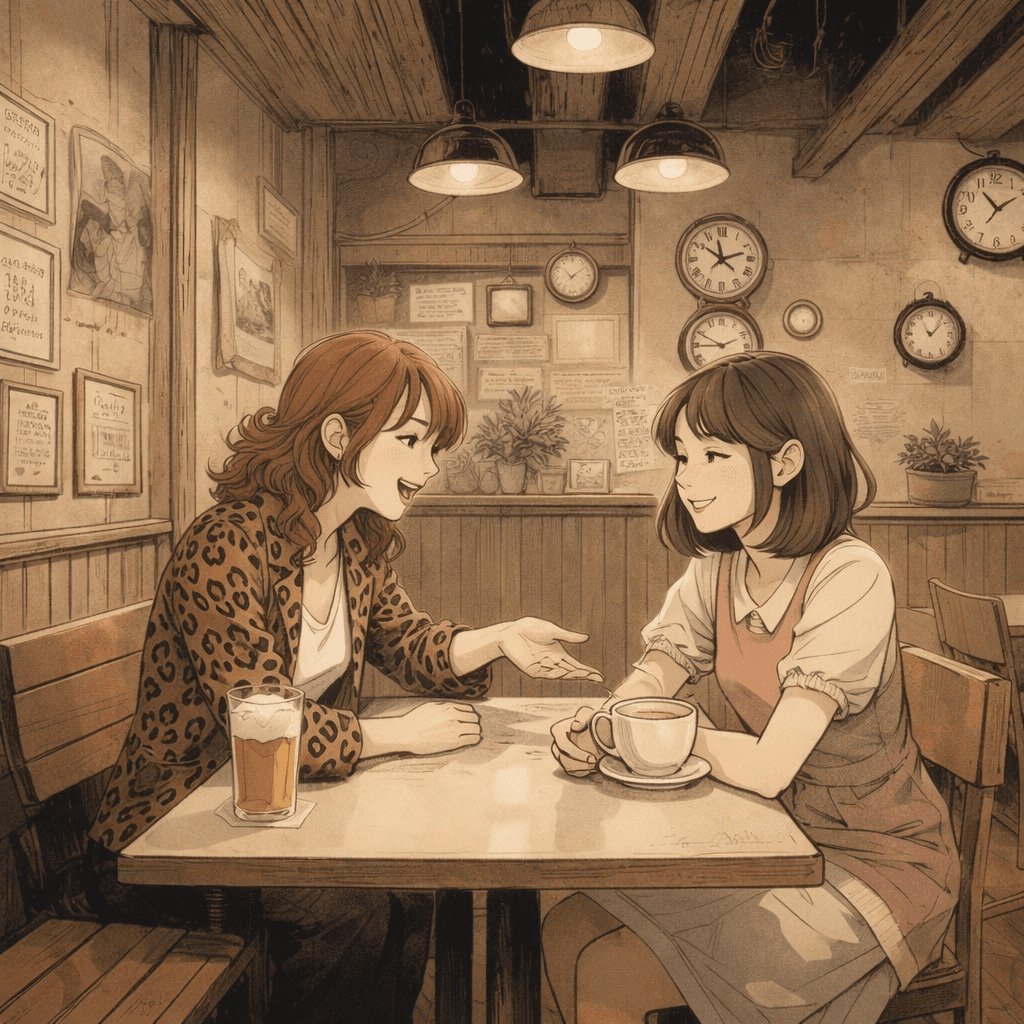 Hirai and Kumi - ChatGPT Image Generation
Yaeko Hirai (aka Hirai) is a successful bar owner who is a regular at the café. Hirai ran away from home at 18 to avoid the responsibilities of inheriting her family’s hotel and taking care of her family.
Kumi is Hirai’s sister, who has been running the hotel on her own and is trying her best to reconcile with her sister. Kumi often visits the café, knowing her sister is a regular at the café, in an attempt to see her and pass along letters.
Hirai has always tried her best to hide from her sister. Any time Kumi attempts to meet her to reconcile, Hirai hides at the café or runs off in an attempt to avoid her. One year, during another one of Kumi’s attempts at reconciliation, Kumi gets into an accident and dies.
Hirai is filled with immense guilt knowing her sister died trying to reconcile with her, using the café to go back in time to imagine what her relationship with her sister could have been had she let Kumi into her life.
As someone who took a lot of adult responsibilities growing up, and as an east asian, I can understand what Hirai felt before she ran away from home. One of the most challenging aspects of these situations is knowing how to separate what’s in your control and what’s not.
You are born into your family, you don’t have a choice into the situation you are born into. It’s counter-productive to dwell on your circumstances rather than taking meaningful action. When you play poker, you may complain about the hand you’re given, but you get past it and do what you can with what you have.
While Hirai and Kumi’s relationship mainly teaches people about being a better communicator with those you love, they taught me more about being forward looking and being agile.
Complaining about your circumstances can only get you so far. It’s self-deprecating and cyclical. Time only moves forward, not backwards. We need to make sure we move forward with time, not be left behind.
There are many ways Hirai and Kumi’s relationship could have been improved before the tragedy, but I think understanding Hirai’s situation tells a more interesting story of how failing to move forward in time can snowball and affect many aspects of our relationships.
Wrapping Up
There are a couple of other characters and lessons in “Before The Coffee Gets Cold” that I don’t dive into, but these stories are the ones that I took away the most from.
Most importantly, I think it’s important to live life without regret. Say what’s on your mind before it’s too late.
Cherish the moments you have with your loved ones before they don’t have the ability to cherish them with you. Do what you can with the hand you’re given in life. At the end of the day, you don’t have a time machine to make peace with your regret.